
J. Perego, C. X. Bezuidenhout, S. Bracco, B.-Q. Song, M. Shivanna, S. Mukherjee, M. J. Zaworotko and A. Comotti
JACS 2026, 148, 8, 8700-8710
Abstract
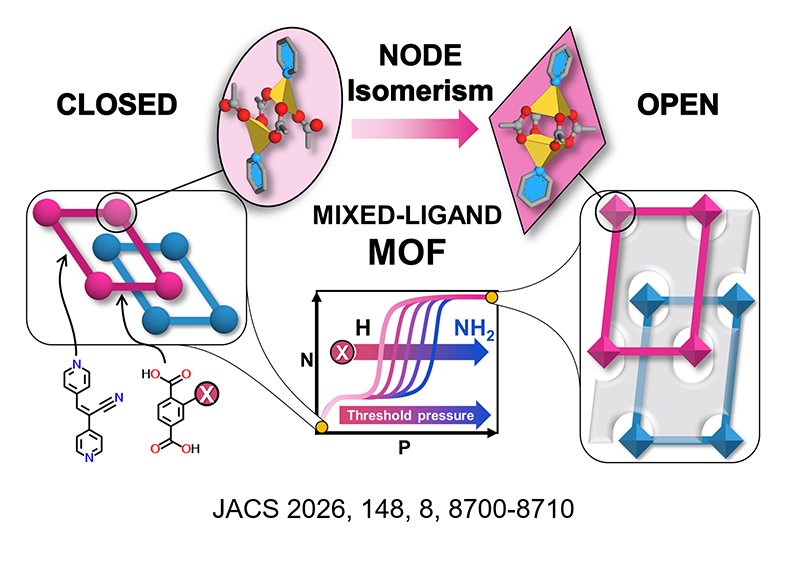
Flexible metal−organic frameworks (MOFs) promise access to superior control and enhanced performance for gas separation, storage, and release. For the development of smart materials with “on-demand” responsiveness, the ad hoc design of switching mechanisms is crucial to drive multiple structural transformations. In this study, doubly interpenetrated pillared Zinc(II)-MOFs were customized to fine-tune CO2 and C2H2 sorption/desorption pressures by modulating their dynamic responses. The incorporation of a specifically designed asymmetric bipyridyl-acrylonitrile pillar, together with benzenedicarboxylate and/or amino-benzenedicarboxylate ligands, leverages reversible metal-coordination isomerism to control gas-stimuli responsiveness. The sophisticated mechanism and temporal response involve framework expansion, node rearrangement, and ligand displacement. Furthermore, evolution of the global dynamics of the framework under cyclical CO2 stimuli was revealed, demonstrating a progression from switching behavior to a permanently open structure. The pore-opening threshold pressure for CO2 and acetylene (C2H2)─from discrete pockets to one-dimensional and two-dimensional interconnected channels─was rationally governed by increasing the amine group content, which modulates the density of hydrogen bonds between the two interpenetrated frameworks. This intricate mechanism was elucidated through in situ PXRD under CO2 atmosphere, calorimetry-coupled gas adsorption, and density functional theory calculations. Notably, C2H2-induced gate opening expands the feasibility of C2H2-responsive systems, offering safer and more efficient sorbents.